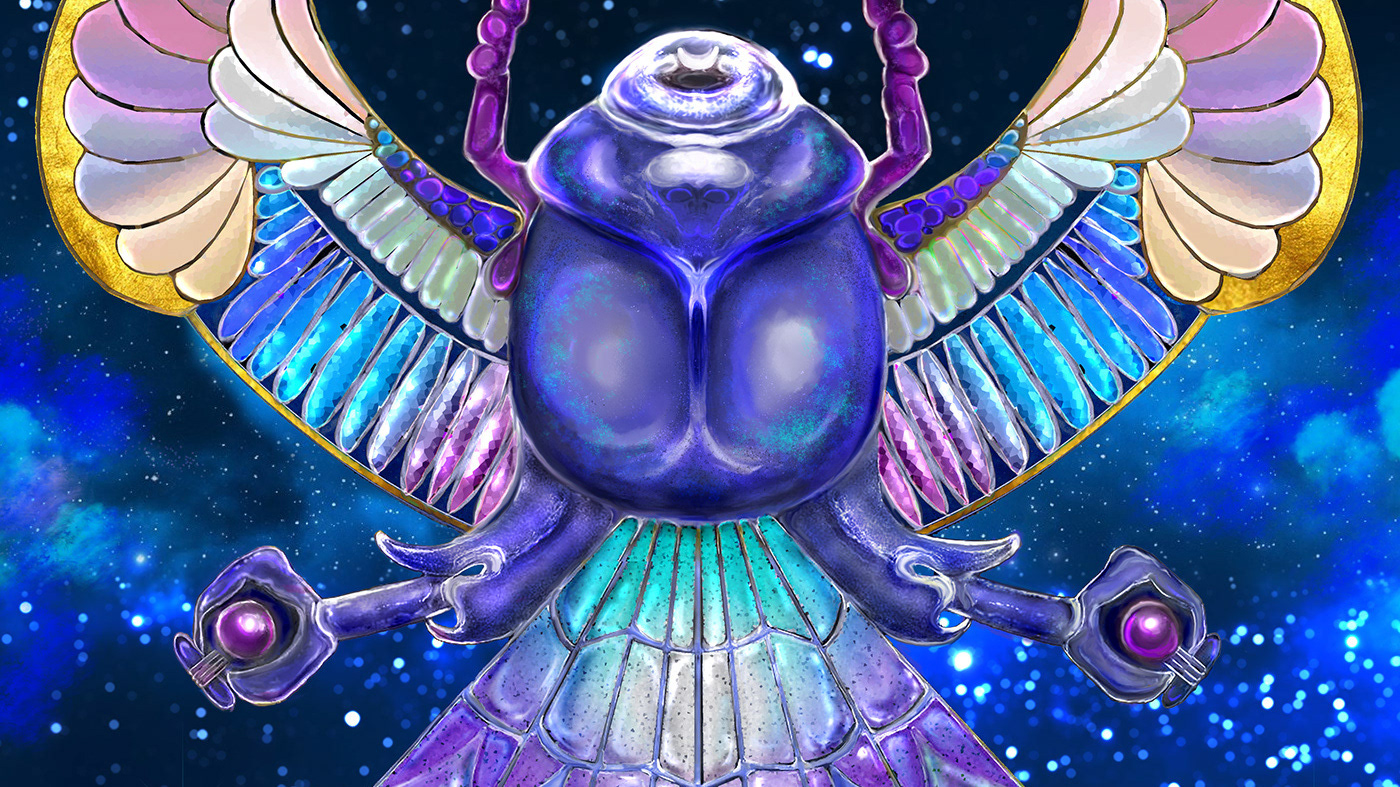

The Hebrew letters that spell out the word Mer-ka-bah are Mem-Raish-Caf-Bet, from the original root word, Raish-Caf-Bet, meaning to ride. Mer-ka-bah, and two related words, mer-kab and re-kev, are usually translated as chariot, sometimes as wagon, but they really are equivalent to the English word vehicle, or conveyance, that is, something that transports you somewhere. This root has come down in modern Hebrew in the word rakevet, which means railroad.
Now the story gets more interesting when we remember that the most ancient teaching of the Kabbalah, that is of the occult and mystical tradition within Judaism, was the Merkabah meditation. The Talmud mentions the Merkabah meditation when it says that Judah the Prince forbade any mention of it in the Mishnah, presumably because it was a mystical teaching. However, references to it in the Tosefta, which is kind of an appendix to the Mishnah, as well as some surviving manuscripts point to Merkabah meditation being practiced at least as far back as the second century BC.
Although we can only speculate, it appears that Merkabah practitioners combined meditation, prayer, and yogic postures in such as way that they ascended, or descended, in their merkabahs, in their vehicles, to realms where they literally saw angels, celestial halls, and the throne of glory itself.
Now, at least one question that comes to mind is, "Where did these Kabbalists really go?" The best answer I can come up with is, "They traveled to other dimensions of reality."
Both the scientific community and those of mystical/occult leanings seem to be headed toward a shared understanding that, as far as reality goes, what we see isn't all we get, that is, the physical reality that we perceive isn't the only one there is. It's the only one we're tuned to, and it is increasingly clear that there are other realities, or dimensions of reality, if you will, that exist simultaneously in time and space with this one. It's kind of like the channels on your TV. If someone said to you, "My TV doesn't get HBO, but last night I hooked up a satellite dish and I watched a movie on HBO," you wouldn't say to him, "You only dreamed you watched HBO," or "You hallucinated that you watched HBO." We would accept that the satellite dish allowed him to tune into a wavelength that his TV set couldn't receive. In a similar way, the practitioners of the Merkabah meditation, and the prophets as well, I would propose, had mastered an art of tuning into a different, and higher, dimension of reality.
The multi-dimensional nature of reality, as well as the ability to move between dimensions, also explains how being such as angels are able to appear and disappear at will, merely by tuning into and then out of our dimension of reality. Devas, fairies, and even UFO's can be similarly explained.
But let's get back to the Bible.
The most striking example of Merkabah meditation is found in yet another prophetic book, second Kings, in the story of Elijah.
Now, in the Jewish tradition, Elijah is the most beloved of all the prophets. A glass of wine for him at the Passover seder, and a chair is set aside for him at a ritual circumcision. These symbolic gestures invite Elijah to join in these celebrations. Why is Elijah invited, and not any other figure from the Bible or Jewish history and legend?
Because Jewish tradition holds that it will be Elijah that comes to announce the arrival of the Redemption. In the Gospels, Elijah is mentioned over two dozen times (under his Greek name "Elias"), and it is always in this connection.
Now, haven't you ever wondered why Elijah has this honor? Why not Moses, for instance, or King David, who, after all, is the root of the line that is supposed to produce the Messiah.
Jewish tradition holds that Elijah will be the forerunner of the Messiah because...
Because Elijah never died! It says so right in the Bible! In the second chapter of the second book of Kings, we read that Elijah and his disciple Elisha were on a walking tour of Judah. At Bethel, the brotherhood of prophets came out to greet Elijah. At Jericho, the brotherhood of prophets came out to great Elijah. Fifty of the brotherhood follow them to the ford in the Jordan.
Who were these brotherhoods of prophets? The Hebrew phrase that describes them b'nai ha-nevi'im appears NOWHERE ELSE in the Bible. This fact alone hints at something very special, perhaps that these brotherhoods were ancient Jewish mystery schools, akin to the mystery schools of Egypt and Persia, where inter-dimensional travel was taught.
The story continues. Elijah and Elisha cross the Jordan. Suddenly a merkabah of fire appears and Elijah disappears in a whirlwind.
That's it. On the third dimension of reality, the one we're attuned to, Elijah has disappeared!
Now most scholars of the rationalist bent explain these verses in the following way: Elisha had a "vision" of a war chariot of fire and in this disassociated state he "imagined" something chaotic (the "whirlwind"), and that this was how he experienced the physical death of his master. Nevertheless, we find something very curious going on with this word "whirlwind", which indicates, I believe, that we are dealing here with more than a hallucination.
It is known that inter-dimensional travel involves counter-rotating energy fields, vortices, if you will, or whirlwinds, if you are viewing it from the perspective of 850 BC. This detail in the story supports the notion that Elijah actually travelled somewhere else.
For many people, this seems far-fetched. And so, I'm going to leave you with one last detail which suggests very strongly that there is some mystery hidden in the story of Elijah's ascension. And that is that in these two verses, and nowhere else in the Hebrew bible, the word for "whirlwind" is mispelled.
For the Masoretic scholars in Tiberias who fixed the prononciation of the Hebrew bible in 900 AD to have misspelled "whirlwind" in only these two verses implies that there was an oral tradition that was kept alive since the Babylonian exile, that is, for fourteen hundred years that said "Spell it s'oroh everywhere else in the bible, but in these two verses, spell it suh-oroh!" The survival of this odd pronunciation, diligently passed on orally from generation to generation, through all of the wanderings and dislocations of the Jewish people, indicates something very special about these verses.
Any interpretation of documents and traditions this ancient is open to question. Nevertheless, it seems obvious that this unbroken tradition of the misspelling of the Hebrew word for whirlwind is meant to alert us to something uncanny in this story. Would it be far-fetched to say that this odd spelling is saying to us:
Do not accept that Elisha has a vision of a war chariot of fire and a whirlwind that Elijah seemed to disappear into.
Imagine, rather, that Elijah entered a Merkabah, a thought-form vehicle, and ascended out of our dimension of reality in counter-rotating fields of energy, the whirlwind, without leaving his physical body.
In a little-known Kabbalistic text, the Midrash to Proverbs, Rabbi Ishmael says,
If there comes before God one who is learned in the Talmud, the Holy One says to him: "My son, since you have studied the Talmud, why have you not also studied the Merkabah, to perceive my splendor? For none of the pleasure I have in my creation is equal to that which is given me when scholars look beyond the Torah and see and behold and meditate on:
My throne, and the hashmal seen by Ezekiel, and the fiery streams under my throne, and the bridges that cross it, and the ofanim [a class of angels], and the gilgalim [another class of angels]. And is this not My greatness, and My glory and My beauty: that my Children know My splendor by seeing all this?"
Rabbi Ishmael concludes:
And this is what King David meant when he wrote in the Psalms: "O Lord, how manifold are thy works!"
| Moses 1:11. I beheld his face, for I was transfigured before him. 25. He [Moses] beheld his glory again, for it was upon him. [Zechariah, Mary, the shepherds in the field, the apostles on the Mount of Transfiguration, etc., all were "sore afraid" in the presence of heavenly glory. Italics added.] | 1 Enoch 71:1. And. . . my
spirit was translated and it ascended into the heavens:
and I saw the holy Sons of God. 10. And with them the Head of Days, His head white and pure as wool, and his raiment indescribable. 11.And my spirit was transfigured. [Italics added.] BHM 5:170. The Metatron[Enoch]
. . . said to me: Come in peace, . . . and they guided
Gizeh 14:24. And I was upon
my face. . . and
|
Discovered
in Gaza, Israel, a Jewish silver coin (D) of 450-300 B.C. shows
a seated figure on a winged, wheeled throne, a reminder that the throne of God is commonly called the merkabah, wagon
or boat, in Jewish literature. Made under
Greek influence, it resembles Dionysius on his winged, wheeled throne
(E) from a Greek vase of 500-400 B.C.
| 2 Nephi 4:24. My voice have I sent up on high; and angels came down and ministered unto me. 25. And upon the wings of his Spirit hath my body been carried away upon exceeding high mountains. And mine eyes have beheld great things, yea, even too great for man; therefore I was bidden that I should not write them. | BHM 5:170. R. Ishmael:
When I went up to the mountaintop to contemplate the Markabah, I entered into the six temples, room by room. Arriving at the entrance to the seventh [the Holy of Holies], I stood to pray before God; and I lifted up my eyes and said: Lord of Eternity, . . . grant me in this hour the crown of the priesthood. . . . And deliver me from Satan. And the Metatron [Enoch] came who [served?] the angel, the Prince of the Presence, and spread his wings and came to meet me with great joy. . . and he took me with his hand and raised me up. |